Most parents reading this page are measuring something — the gate width, the backyard, the ceiling of a church gym, the distance from the back patio to the nearest outlet. The specs below cover everything you actually need to plan around for a toddler bounce house rental in DFW. Save this section, send it to anyone helping with setup, and refer back to it when you are figuring out where the unit will go.
Toddler Bounce House Setup Specs at a Glance
FOOTPRINT
Approximately 15-20 feet long × 15-18 feet wide
INDOOR CLEARANCE
10-12 feet of ceiling height minimum
GATE / PATH WIDTH
4 feet minimum clearance for delivery
ELECTRICAL
1 dedicated 110v outlet within 100 feet (blower draws 12 amps)
AGE RANGE
Ages 2-7 (designed specifically)
RIDER CAPACITY
4-6 toddlers at a time (check product listing)
SUPERVISION
1 dedicated adult + 1 backup for rotation
WIND CUTOFF
15 mph sustained / 20 mph gusts
SURFACES
Grass (stakes), concrete (sandbags), indoor (sandbags)
RENTAL PERIOD
8 full hours included (extend at +7%/hr)
Toddler bounce houses are not just smaller versions of standard bounce houses. They are engineered differently from the ground up to remove the specific risks that come with little bodies. Four design choices separate a true toddler unit from a regular bounce house with a "for kids" label slapped on it.
How Toddler Bounce Houses Are Designed for Safety
Open-Top Design for Constant Visibility
A regular bounce house has a roof and small mesh windows. A toddler bounce house has no roof at all. The open top lets parents see every child from every angle without climbing inside. It also significantly reduces blower noise inside the unit, which matters because loud, enclosed spaces are one of the top reasons toddlers refuse to play in inflatables.
Shorter, Gentler Slides
Toddler combo slides are typically 4-6 feet tall with a gradual slope. Standard combo slides are 8-12 feet with steeper angles built for elementary-age kids. The reduced height means shorter falls and slower exit speeds. Toddlers can climb up and slide down without an adult lifting them, which builds confidence and prevents the most common slide injuries.
Slanted Climbing Walls
Standard climbing walls are nearly vertical and require upper-body strength. Toddler climbing walls are angled at roughly 30-45 degrees so a 3-year-old can crawl up on their hands and feet without help. The reduced angle means falls from the climbing wall are short and onto soft inflated surface — not the hard-impact tumbles you see on older-kid units.
3D Pop-Ups Sized for Small Bodies
Toddler bounce houses include 3D character pop-ups positioned throughout the bounce area. These obstacles are sized so toddlers can navigate around them, climb over them, and bounce against them safely. They keep short attention spans engaged so toddlers do not get bored and start doing things they should not do — which is when most minor injuries happen.
A 2-year-old and a 7-year-old are very different riders, even on the same toddler bounce house. Knowing what safe play actually looks like at each age helps parents supervise more effectively and avoid the small problems that turn into bigger ones. Here is what to expect and what to watch for across the toddler age range.
Age-Specific Safety: Ages 2-3, 4-5, and 6-7
Ages 2-3: Constant Direct Supervision
Toddlers 2-3 should have an adult either inside the unit or close enough to step in within two seconds. Limit time inside to 5-10 minutes at a stretch — younger toddlers tire fast and overstimulation is when accidents happen. Skip the slide on the first few bounces while they get used to the surface. Only one or two toddlers at a time in this age range.
Ages 4-5: Independent Play With Watchful Eyes
Four and five-year-olds can use a toddler bounce house mostly on their own with an adult watching from outside. The open-top design makes this easy. Three to four kids of similar size can play at once. Watch for the social dynamic — older 5-year-olds sometimes get rougher when they want to "teach" younger toddlers how to bounce. Step in early.
Ages 6-7: The Upper Edge of Safe Use
Six and seven-year-olds are at the top of the toddler bounce house age range. They are still safe to use the unit, but the bounce area can feel small for them and they may want to do tricks. Limit to 2-3 kids this age at a time, and consider renting a standard combo bounce house alongside if you have multiple kids this age at the party.
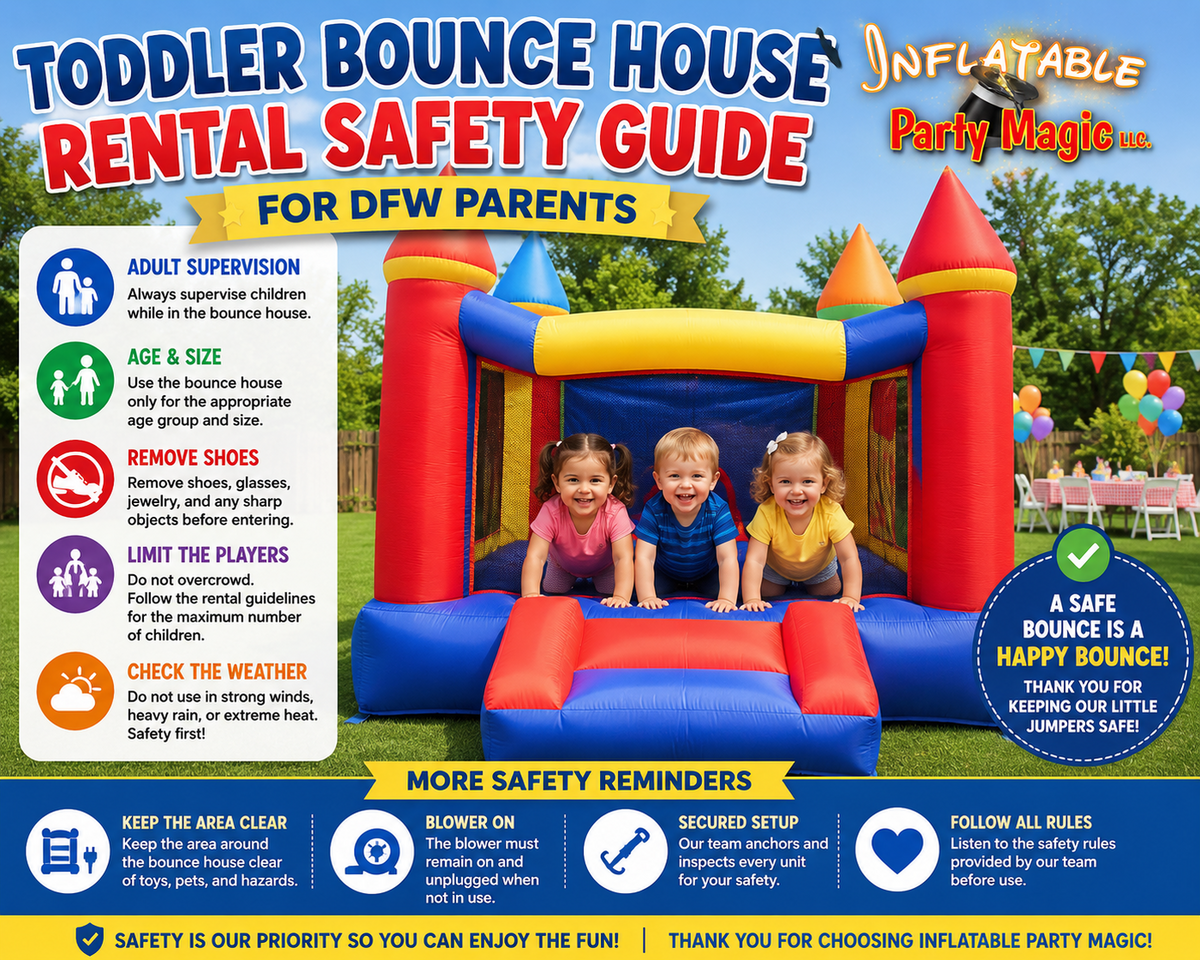
Supervision is the single biggest factor in toddler bounce house safety. Almost every preventable injury comes down to a supervision lapse — adult got distracted, capacity got exceeded, a bigger kid jumped in for "just a minute." These four rules cover the majority of real-world risk and keep your toddler safe through an entire party.
Supervision Rules That Keep Toddlers Safe in a Bounce House
One Adult Eyes-On at All Times
Designate a specific adult — not "everyone watching" — to monitor the bounce house at all times during the party. Rotate every 20-30 minutes if the party is long so no one zones out. The supervisor cannot be the person handling food, drinks, gifts, or phone calls. Their only job is watching the bounce house and the kids inside it. Read our full bounce house supervision guide for a deeper walkthrough.
Respect Capacity Limits — Always
Every toddler bounce house has a maximum number of riders specified on the product listing. Typical capacity is 4-6 toddlers depending on the unit. Going over capacity is the most common cause of collisions and falls. If three kids are inside and a fourth wants in, the third kid comes out first. Make this rule clear before the party starts so the supervisor is not negotiating with kids in the moment.
No Shoes, No Glasses, No Sharp Objects
Shoes damage the vinyl and turn kicks into harder impacts. Glasses break or cut. Toys, jewelry, hairpins, anything sharp — leave it outside. Set up a shoe bin and a "stuff" bin right at the entry so the rule is visual, not verbal. Socks are fine and recommended on bare-foot-sensitive surfaces. Empty pockets too — a single Hot Wheels car becomes a real hazard inside a bouncing inflatable.
Never Mix Toddlers With Bigger Kids
This is the single most important rule. A 50-pound 6-year-old bouncing next to a 25-pound 2-year-old is the setup for almost every serious toddler bounce house injury. Bigger kids do not mean to hurt smaller ones — they just do, because of physics. If your event has mixed ages, rent a separate combo bounce house for older kids so the age groups never share equipment.
A typical toddler bounce house party in DFW runs about two hours from first guest to last goodbye. After 24 years of watching how these parties flow, we can tell you what works at each stage — when kids will and will not want to bounce, when to do cake and gifts, and how to wind down without meltdowns. The four phases below cover the rhythm of a successful toddler birthday party with a bounce house.
The Toddler Bounce House Party Timeline: What Actually Works
The First 15 Minutes: Arrivals and Warm-Up
Most toddlers do not run straight to the bounce house. The first 15 minutes are quieter than parents expect — kids cling to their parents, watch from a distance, and warm up to the room before they commit. Resist the urge to push them in there. Let toddlers explore the space at their own pace. The early-arriver kids will go first, the slower-warm-up kids will follow once they see it is safe.
The Main Hour: Peak Bounce Time
Around the 20-minute mark, the party shifts. Kids stop watching and start playing. This is the hour the bounce house earns its rental price. A 5-on / 5-off rotation works well — a few minutes inside, a few minutes outside for water and breath. Save cake and gifts for the back half of this hour, not the start. Bouncing right after cake combines sugar, motion, and excitement, which is when toddlers tire out fastest.
The Wind-Down: Last 30 Minutes
Start signaling the end about 30 minutes before the party officially wraps. Give a 10-minute warning, then a 5-minute warning. Move a quieter activity — book reading, sticker pages, a snack — near the bounce house so kids have somewhere to land when they exit. Plan to close the bounce house 15-20 minutes before guests leave. Closing it early prevents the toddler meltdown of "but I was still bouncing" right as parents are trying to leave.
The Wrap-Up: Final 15 Minutes and Pickup
The last 15 minutes are for goodbye hugs, goodie bags, and a final group photo near the bounce house before our crew arrives for pickup. Let parents know in advance that pickup happens at the scheduled time — they do not need to be there for takedown. Our delivery crew handles all deflation, packing, and loading. This is also a nice moment for the birthday parent to thank the bounce house supervisor in front of everyone.
Weight limits exist for two reasons: protecting the child and protecting the structure. Most parents focus on individual rider weight, but the combined weight of all riders is just as important. Going over total capacity changes how the unit bounces and concentrates impact forces on small bodies.
Weight Limits and Capacity for Toddler Bounce Houses
Individual Rider Weight
Most toddler bounce houses have a per-rider weight limit of around 75-100 pounds. This is well above what a typical 7-year-old weighs, so individual weight is rarely the binding limit at toddler parties. The specific limit for each unit is listed on the product page.
Total Unit Capacity
Total combined rider capacity is usually 4-6 toddlers or roughly 300-400 pounds total, whichever comes first. This is the limit that matters in practice. Six toddlers averaging 35 pounds = 210 pounds total, well within range. The capacity for each specific unit is on the product listing.
Why Mixing Sizes Breaks the Math
One 60-pound 8-year-old plus three 30-pound toddlers = 150 pounds — well under the weight limit. But the dynamics are still unsafe because the larger child creates bigger bounces that throw smaller riders off balance. Total weight under limit does not equal safe — keep age and size groups separate regardless.
Where the toddler bounce house sits affects how it is anchored and how safe it is. Grass is the gold standard, but DFW parties happen on driveways, patios, parking lots, and inside church gyms every weekend. The right anchoring method makes any of these surfaces safe — the wrong one creates a tipping or shifting risk.
Setup Surface Safety: Grass, Concrete, and Indoor Floors
Grass: Stakes Are the Safest Anchor
Level grass is the ideal surface. Our delivery crew uses long metal stakes driven through the unit's anchor points directly into the ground. Stakes hold against wind and bounce forces better than any other anchoring method. The yard should be roughly level — a small slope is fine, but anything steep enough to roll a ball is too much.
Concrete and Asphalt: Sandbag Anchoring
Driveways, patios, and parking lots get sandbag anchoring instead of stakes. Heavy sandbags placed at every anchor point provide equivalent hold. Our crew calculates the number of sandbags based on the unit size and any wind forecast for your event. Concrete setups are safe and common — just confirm with us during booking so we bring enough weight.
Indoor Setups: Sandbags and Ceiling Math
Church gyms, school cafeterias, and community center floors all work for toddler bounce houses with sandbag anchoring. The two things to verify in advance: ceiling height (toddler combos need 10-12 feet of clearance) and floor space dimensions. Wind is not a factor indoors, which is one reason indoor setups are actually some of the safest options.
Texas weather can change fast, and inflatables react to weather faster than parents do. Knowing the conditions that make a toddler bounce house unsafe means knowing when to call kids out — before the weather forces the issue. Our delivery crew monitors conditions and will reach out proactively, but the on-site supervisor needs to know the rules too.
When Weather Makes a Toddler Bounce House Unsafe
Wind: 15 MPH Is the Cutoff
Sustained winds over 15 mph or gusts over 20 mph mean kids come out immediately. Toddler bounce houses are lighter than larger units and react to wind sooner. Check the forecast the morning of your party. If wind is borderline, plan for an indoor backup or move the unit to a more sheltered area of the yard.
Rain and Lightning: Empty Immediately
Even light rain makes the bounce surface slippery and unsafe for toddlers. Get kids out at the first drops. Lightning anywhere within roughly 10 miles means evacuate and shut down the unit until the storm is well past. The blower motor must be unplugged in lightning conditions to prevent electrical risk.
Heat: Above 95°F Take Breaks
Vinyl surfaces get hot fast in direct Texas sun. Above 95°F, limit toddlers to 10-15 minute play stretches with shade and water breaks in between. Set up the unit in the shade if possible, or rent a tent to provide shade over the entry area. Watch for flushed faces — toddlers do not always know they are overheating.
Cold: Below 50°F Is Still Fine Indoors
Toddler bounce houses work fine in cold weather as long as the setup is indoors. Outdoor winter use below 50°F is not recommended — the vinyl gets stiff and less forgiving on impact, and toddlers cannot regulate body temperature as well as older kids. For winter birthdays, set up inside a heated space.
A safe toddler bounce house starts with a rental company that does the unglamorous work — annual inspections, real cleaning between rentals, full insurance coverage, training for the delivery crew. Many DFW operators skip one or more of these. Before you book with anyone, ask the questions in the cards below. The right rental company will answer all six without hesitation.
What to Look For in a Toddler Bounce House Rental Company
Annual State Inspection
Texas requires every commercial inflatable to be inspected annually by the Texas Department of Insurance. Ask for the inspection certificate. Inflatable Party Magic's units are all state-inspected by TDI every year — no exceptions, no expired stickers.
$1 Million Liability Insurance
Any reputable inflatable rental company carries a minimum of $1 million in liability coverage. Some operators skip insurance to lower their prices — that risk transfers to you. View our insurance details and request a COI for school or church events.
Real Cleaning Between Rentals
Ask what the cleaning process actually is — not just whether they "clean." Inflatable Party Magic uses a 4-step process: inspection, deep clean, sanitization with CDC-approved disinfectants, and a final pre-delivery check. Toddlers put their hands and mouths on everything, so this matters more than it sounds.
Trained Delivery Crew
The crew that sets up your unit should be employees, not random day labor. Trained crews handle leveling, anchoring, and safety walkthroughs the same way every time. Ask how long the company has been in business — Inflatable Party Magic has trained crews on every delivery since 2002.
Age-Specific Inventory
A rental company with only one or two "toddler" options is usually labeling small regular bounce houses as toddler units. A true toddler-specific inventory has 10+ purpose-built toddler combos with open tops, gentle slides, and small climbing walls. Browse our 15+ toddler bounce house options to see what real toddler inventory looks like.
Verifiable Review History
Look at the Google review count and the dates. A company with 50 reviews from the last six months is different from one with 1,200 reviews spanning 20 years. Pattern recognition matters more than star count — look for repeated mentions of on-time delivery, clean equipment, and professional crews.
Most DFW parties include kids across a wide age range. Family reunions, church family days, neighborhood block parties, and HOA events all mean toddlers and bigger kids in the same backyard. The strategy for keeping everyone safe is separate zones — never shared equipment. If your event also includes a water slide for older kids, read our water slide rental safety guide for the rules that apply there. Three practical rules make the toddler zone work.
Mixed-Age Event Safety: Keeping Toddlers Safe With Bigger Kids Around
Set Up Physically Separate Zones
Position the toddler unit at least 15-20 feet from the older-kid unit and create a clear visual separation — tables, chairs, a path, anything that signals "different area." Toddlers gravitate toward where bigger kids are playing. Physical distance breaks that pull.
Assign One Supervisor Per Zone
One adult cannot effectively watch two bounce houses. Assign one supervisor to the toddler unit and a different supervisor to the older-kid unit. They rotate every 20-30 minutes so no one gets fatigued. This is non-negotiable for events with toddlers present.
Brief All the Big Kids Upfront
Before the party starts, the older kids get a 30-second talk: "The small bounce house is for the little kids only. If a little kid wanders into your bounce house, you come find an adult." Bigger kids almost always cooperate when they understand the why — they just need the rule stated out loud.
First-time bounce house renters tend to make the same four mistakes — not because they did not research, but because the things that matter most are not what they thought to research. This is the section to read if you are renting your first bounce house for your first big kid party. The fixes are simple once you know to plan for them.
First Time Renting a Toddler Bounce House? Start Here
Book 3-4 Weeks Ahead, Not 1 Week
First-time renters tend to wait until two weeks out and discover their first-choice unit is already booked. Popular toddler themes — Mickey Mouse, Frozen, Toy Story — book 3-4 weeks in advance for weekend dates in spring and fall. Holiday units (Gingerbread, Elf, Christmas) book 6 weeks out. The earlier you book, the more selection you have. If you are reading this more than three weeks before your party, book now.
Measure Twice, Not Just Once
First-time renters measure the setup area but forget about the path TO the setup area. The crew needs at least 4 feet of gate clearance to wheel the unit in. Walk from the truck-parking spot to the setup spot and measure every gate, walkway pinch point, and overhang along the way. If your gate is 36 inches instead of 48, tell us during booking so we plan for an alternate setup approach.
Plan for Parents, Not Just Kids
First-time renters plan the kids' activities and forget the parents will be standing around for two hours. Rent tables, chairs, and a tent so parents have somewhere to sit in the shade while the kids bounce. A comfortable adult environment makes the supervisor's job easier — they actually sit and watch instead of standing far away on their phone. This single addition prevents more supervision lapses than any other planning step.
Designate Your Supervisor BEFORE the Party
First-time renters assume the supervisor role will sort itself out. It does not. By the time the party is happening, you are handling cake, gifts, and arrivals — not watching the bounce house. Pick a specific adult before the party starts, tell them they are it, and have a backup ready to rotate in. A grandparent, an aunt, or a teenage cousin all work as long as the role is named in advance.
Run through this checklist the morning of your toddler bounce house rental. It takes about five minutes and catches the small issues that turn into real problems mid-party. The Inflatable Party Magic delivery crew handles most of the technical setup, but the host owns the on-site readiness.
Pre-Event Toddler Bounce House Safety Checklist
Before the Crew Arrives
Clear the setup area of debris, rocks, dog waste, and sticks. Confirm the 110v outlet is working and the path to it is clear. Make sure the gate is at least 4 feet wide and the pathway is clear. Move sprinkler heads or mark them with flags so the crew can stake around them, and disable any automatic sprinkler timers for the day.
During Setup
Walk through the unit with the delivery crew. Confirm anchoring is solid at every point. Test the slide and verify the open-top design is fully inflated. Ask any questions about supervision rules before the crew leaves — this is the moment to clarify anything you are unsure about.
Before the First Guest Arrives
Set up the shoe bin and "stuff" bin at the entry. Designate your bounce house supervisor and a backup. Check the weather forecast one more time and have an indoor backup plan if conditions look borderline. Place a water station within sight of the bounce house.
Throughout the Party
Rotate supervisors every 20-30 minutes. Enforce capacity limits — count heads before letting another kid in. Take water and shade breaks every 15-20 minutes in summer heat. If weather changes, empty the unit immediately rather than waiting to see what happens.
Some rentals do double duty as safety enhancements. Shade prevents heat issues. Comfortable seating keeps the designated supervisor close enough to actually supervise. A second bounce house for older kids eliminates the mixing problem entirely. Below are the four most common add-ons that DFW parents pair with a toddler bounce house, and how each one improves safety in addition to comfort.
Safer Together: Add-Ons That Improve Toddler Party Safety
A Tent for Shade
Texas sun above 90°F makes the bounce surface hot and the parents miserable. A tent next to the bounce house gives toddlers a cool space for water breaks and parents a comfortable spot to sit and watch. Most heat-related issues disappear with a single tent rental.
Tables and Chairs
A chair within sight of the bounce house entry means the supervisor actually sits and watches. Standing supervisors get distracted, walk away, or check their phones. Seated supervisors with a clear view stay engaged for the full party. A small table and three chairs near the entry is the highest-leverage safety upgrade you can buy.
A Separate Combo Bounce House
If you have any kids 5 and up at the party, a second combo bounce house with a slide for the older kids is the single best safety investment. It eliminates the mixing problem at the source — no tempting older sibling to sneak into the toddler unit when they have their own bigger and better option right next door.
A Water Cooler Within Sight
Toddlers do not ask for water when they are overheating — they get cranky, flushed, and quiet. A water cooler positioned right next to the bounce house entry makes hydration the path of least resistance. Build it into the party flow: every 15 minutes, kids come out for water before going back in. No negotiating, no nagging.
Good communication on the day of your toddler bounce house rental is the single biggest predictor of a smooth event. For a full walkthrough of the delivery and setup process, see our guide on what to expect on event day. The four checkpoints below cover what to expect from Inflatable Party Magic on event day, what to have ready for whoever is supervising the bounce house, and the three things to confirm the day before so nothing slows down our delivery crew. Save (817) 800-8618 in your phone before the party starts.
Your Day-Of Contact Info and Setup Communication
Save Our Number Before the Party Starts
(817) 800-8618
Save this number in your phone before guests arrive. Use it for questions during setup, weather conversations if conditions look borderline, last-minute timing changes, or anything you want to ask our team. Someone answers when you call — no menus, no holds. Our crew is available throughout your full rental window.
What to Expect From the Delivery Crew
Expect a confirmation call or text the day before with your delivery window. On event day, the crew arrives within that window and walks you through the setup — anchoring points, the entry, the blower outlet, and any rental-specific notes. Takedown happens at the scheduled end time. You do not need to be present for pickup as long as the unit is accessible.
What to Have Ready for the Supervisor
Brief whoever is watching the bounce house before the first guest arrives. They need to know: the maximum rider count for your specific unit (from the product page), the no-shoes rule, where the shoe and "stuff" bins are, and where the water station is. A 60-second briefing is enough — most people just need the rules said out loud once.
Confirm These 3 Things the Day Before
The day before your party, confirm three things: the setup time window matches what you expected, the gate or entry path is unlocked and clear for our crew, and the electrical outlet you planned to use is actually working. Test it with a phone charger. These three checks prevent 90% of day-of delivery delays.
These are the most common questions DFW parents ask about toddler bounce house safety before booking. If your question is not answered here, call us at (817) 800-8618 or visit our FAQ page.
Toddler Bounce House Safety FAQ
At what age can a child safely use a bounce house?
Children can safely use a toddler-specific bounce house starting at age 2. Standard bounce houses are designed for ages 5 and up. Mixing children younger than 5 into a standard bounce house is the leading cause of preventable bounce house injuries because the size and weight differential is too large. Always rent age-appropriate equipment — a true toddler unit for kids under 5, a standard unit for kids 5 and older.
Are toddler bounce houses safer than regular bounce houses?
Yes, when used by toddlers. Toddler bounce houses have shorter slides, gentler climbing walls, open-top visibility, and smaller bounce areas — all designed specifically for the 2-7 age range. Using a regular bounce house for toddlers creates risk because the equipment is sized for bigger bodies. Using a toddler bounce house for older kids defeats the purpose because they outgrow it physically and get bored, which leads to roughhousing. For safety rules that apply once kids age out of toddler units, read our general bounce house safety guide.
How many adults should supervise a toddler bounce house?
One dedicated adult supervisor at all times, with a backup who can rotate in every 20-30 minutes. The supervisor's only job is watching the bounce house and the kids inside it — not handling food, gifts, or phone calls. For larger parties or events where toddlers and older kids both have bounce houses, assign one supervisor per unit. Read our complete bounce house supervision guide for more detail.
What are the most common toddler bounce house injuries?
The most common toddler bounce house injuries are bumped heads from collisions with other kids and minor scrapes from slide exits. Both are largely preventable with capacity limits and age separation. Serious injuries are rare in toddler-specific units and almost always involve a toddler in a standard bounce house with bigger kids — not a toddler in a toddler unit being used correctly.
Can a toddler bounce house tip over in the wind?
A properly anchored toddler bounce house will not tip over in normal weather. The risk increases with sustained winds over 15 mph or gusts over 20 mph. At those wind speeds, empty the unit and either move it to a sheltered area or shut it down until conditions improve. Our delivery crew anchors every unit with either ground stakes (on grass) or weighted sandbags (on concrete or indoors).
Is it safe to put a toddler bounce house on concrete?
Yes, with sandbag anchoring instead of stakes. Driveways, patios, and parking lots all work for toddler bounce houses. Our crew brings sandbags sized appropriately for the unit and the forecast wind conditions. Avoid surfaces with sharp debris, broken concrete, or significant slope. Inside a church gym or community center is also safe and is one of the most popular setup locations for winter toddler parties.
How do I know if a rental company is safe to book?
Ask four questions before booking: Are your inflatables state-inspected by the Texas Department of Insurance? Do you carry at least $1 million in liability insurance and can you provide a COI? What is your cleaning process between rentals? How long has your business been operating? A reputable company answers all four without hesitation. Read our safety standards and view our complete pre-rental research checklist.
What should I do if my toddler gets hurt in a bounce house?
For minor bumps and scrapes — get the child out, comfort them, apply basic first aid, and have them sit out for at least 10-15 minutes before returning. For anything more serious (head injury, suspected fracture, prolonged crying, vomiting), seek medical evaluation immediately. Document what happened with photos and notes. If you booked from a properly insured company, their liability coverage exists for exactly these situations — call them as soon as the child is stable.
Ready to Book a Toddler Bounce House Rental in DFW?
Now that you know what safe toddler bounce house rental looks like, browse our 15+ toddler-specific inflatables — all state-inspected, fully insured, cleaned between every rental, and designed for ages 2-7.
Call (817) 800-8618
TDI State-Inspected
•
$1M Liability Insurance
•
4-Step Cleaning
•
Professional Setup & Takedown
•
Family-Owned Since 2002


.jpg "Frozen Toddler Bounce House Playland- Rents only Dry Year Round")


