Pre-Party Safety Checklist: Your Complete Guide
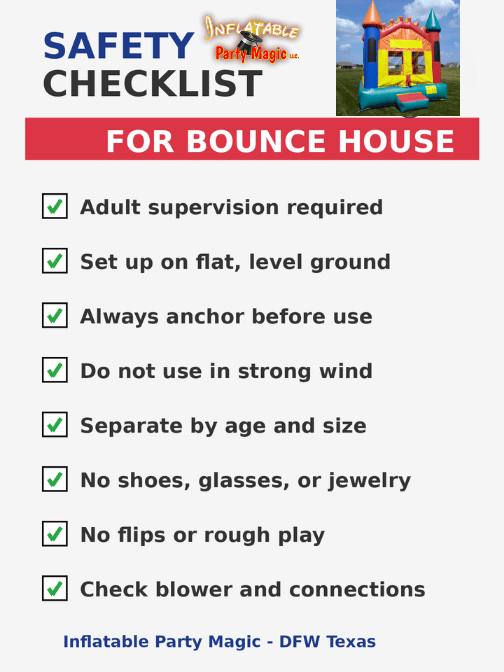
Print this checklist and review it before your bounce house party:
One Week Before:
- ☐ Confirm rental reservation and delivery time
- ☐ Check weather forecast and discuss backup plans
- ☐ Measure setup area to ensure adequate space
- ☐ Identify and clear overhead obstacles (branches, wires)
- ☐ Locate GFCI outlets within 100 feet of setup area
Day Before:
- ☐ Re-check detailed weather forecast
- ☐ Assign adult supervision shifts (write them down)
- ☐ Mow grass in setup area if needed
- ☐ Clear setup path from driveway to bounce house location
- ☐ Remove sprinklers, lawn decorations, pet waste, dog toys from area
Morning Of Party:
- ☐ Check current wind speed (must be under 15 mph)
- ☐ Inspect setup area for new hazards
- ☐ Ensure pets are secured away from setup area
- ☐ Remove pet waste
- ☐ Have emergency phone numbers accessible for all party guests left without parental supervision
- ☐ Designate a "no shoes/jewelry" station near bounce house
During Setup:
- ☐ Supervise setup process (don't leave crew unattended)
- ☐ Verify proper anchoring (stakes or sandbags)
- ☐ Test bounce house inflation and stability
- ☐ Review safety rules with delivery crew
- ☐ Note emergency shutdown procedures
- ☐ Get crew contact number for questions during event
- ☐ Take photo of posted safety rules for reference
Before Children Enter:
- ☐ Announce rules to all children and parents
- ☐ Establish age groups and rotation schedule
- ☐ Position first adult supervisor
- ☐ Set up hydration station nearby
- ☐ Final wind speed check
During Event:
- ☐ Rotate supervisors every 30 minutes
- ☐ Monitor weather conditions hourly
- ☐ Enforce capacity limits strictly
- ☐ Take water breaks every 20 minutes if hot
- ☐ Address rule violations immediately
- ☐ Check anchor points if wind increases
Frequently Asked Questions About Bounce House Safety
Can adults use bounce houses with children?
Generally no. Adults weigh significantly more than children, creating collision hazards and potentially exceeding weight limits. If adults want to use a bounce house, they should do so separately from children, and only in commercial-grade units rated for adult weight (typically 800+ lbs capacity). Many family injuries occur when well-meaning parents try to "help" children inside the bounce house.
What should children wear in a bounce house?
Children should wear comfortable, fitted clothing without drawstrings or loose items that could catch on surfaces. Athletic wear works well. Remove: shoes, socks with grips (regular socks or barefoot is safest), jewelry, glasses, hats, hair accessories, and empty all pockets. Avoid: costumes with capes, princess dresses with long skirts, or any clothing with hard embellishments.
How often should bounce houses be cleaned?
Professional companies should clean and sanitize bounce houses after every single rental using EPA-approved disinfectants. At Inflatable Party Magic, we follow a five-step process: debris removal, washing with commercial cleaners, sanitization with hospital-grade disinfectants, complete drying to prevent mold, and final inspection. If a rental company can't describe their cleaning process in detail, look elsewhere.
What if it rains after the bounce house is set up?
Light drizzle usually isn't dangerous - kids are getting wet in water slides anyway. However, evacuate immediately if: lightning is present, rain becomes heavy (slippery surfaces), or wind increases. Professional companies like ours cover bounce houses during rain if you want to wait out a brief shower, but won't leave equipment set up overnight in wet conditions due to mildew concerns.
Do I need special insurance for a bounce house rental?
Your homeowner's insurance may cover injuries at events on your property, but this varies by policy. The rental company's insurance typically covers equipment failure but not user injuries. For large events (graduation parties, neighborhood gatherings), consider a special event liability policy. For typical birthday parties at your home, verify your homeowner's policy covers guest injuries and ensure your rental company carries minimum $1 million liability insurance.
Can bounce houses be used indoors?
Yes, but with specific requirements: ceiling height must be at least 15 feet above the highest point of the bounce house, the room must have adequate ventilation for the blower motor, there must be open space on all sides for safety access, and the floor must support the combined weight. Church gyms, school cafeterias, and large recreation rooms often work well. Residential garages rarely have sufficient height clearance.
How long do bounce houses take to set up?
Professional crews typically need 15-30 minutes for standard bounce houses, depending on size and complexity. Large obstacle courses or combo units may take 45-60 minutes. Setup time factors include: distance from vehicle to setup location, surface type (grass setup is faster than concrete with sandbags), weather conditions, and crew size. Never rush the setup process - proper anchoring and inflation checks are critical for safety.
What's the difference between commercial and residential bounce houses?
Commercial bounce houses use heavier-duty vinyl (18-22 oz), reinforced stitching, and commercial-grade zippers designed for frequent use. Residential units use lighter materials (13-15 oz vinyl) appropriate for occasional backyard use. Commercial units are inspected more frequently and designed to industry safety standards. When renting for parties, you're getting commercial-grade equipment designed for public use - much safer than consumer-grade units available at retail stores.